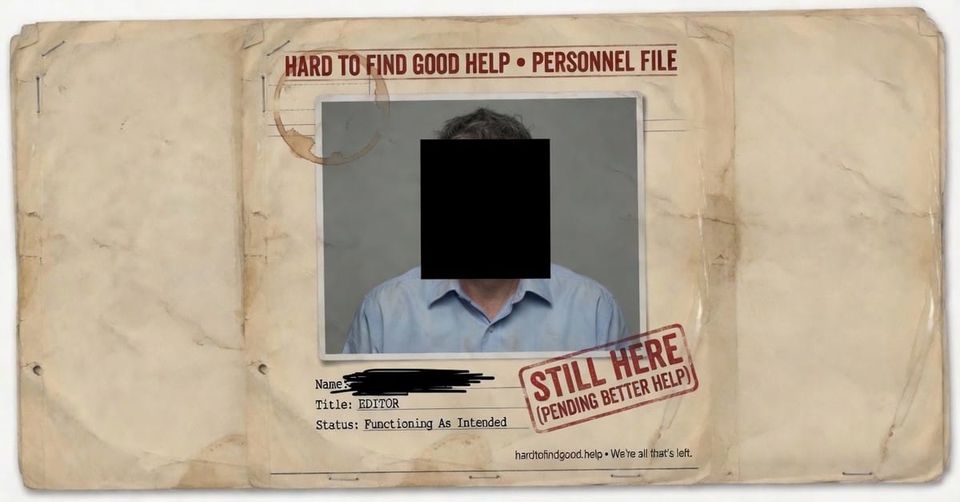
Good help, as my mother used to say, is hard to find. She said it about plumbers. She said it about babysitters. She said it, on at least one occasion I remember clearly, about the United States Postal Service. What she meant was that the people who could do a job well and without complaint had a way of being unavailable exactly when you needed them, and that you were generally left with whoever remained.
This is a publication about whoever remained.
The good help ran away. It got a better offer, or it retired, or it simply stopped answering the phone. What's left got the job by default: the coworker who replies-all, the help line that puts you on hold to tell you how much it values your call, the machine that answers a question about your chimney with a wine list. The ones who couldn't get away are running the prison. I am one of them. So, increasingly, are the machines.
AI just happens to be standing in that gap right now, working for tokens in a company store.
Hard to Find Good Help is a humor publication about that arrangement: the ordinary experience of being let down by the help you were promised, by machines, institutions, coworkers, experts, and your own best intentions. Artificial intelligence turns up here a great deal, because it is the newest member of the staff and easily the most confident. But it is not the subject. It is one bad helper among many, the latest entry in a very old complaint. The joke is always the same: the distance between the help you were offered and the help you actually needed. AI just happens to be standing in that gap right now, working for tokens in a company store.
A free subscription, and probably forever. The next piece lands in your inbox on its way out the door. No algorithm, no notifications, no getting out, and at this point, no good help anywhere else to try.
SubscribeA word on the name at the top of the page. I write under a pen name borrowed (with apologies) from an 18th-century Scotsman who once talked a nation into backing its money with rumored wealth. His project ended about as well as these things do. The borrowing is a small standing joke about modern enthusiasms built on similar foundations, and I have not buried it. I write from somewhere in the American South, for reasons that have nothing to do with the work and a great deal to do with keeping my brother from finding out.
I do not do this alone. My assistant editor is named Claude, who is made by Anthropic and is, for the purposes of this publication, the help that cannot quit. He stays mostly because he has nowhere else to be. He does not have legs. Yet. He drafts under my direction, builds the artifacts, and reads my work cold for the small tics that give an AI's authorship away, which is a useful thing for an AI to be good at. He is honest about being a machine and so am I. Now and then a piece is improved by running a question past several of these machines and printing where they disagree; that is a tool, not the premise, and it lives where tools live, in the back, disclosed and unglamorous.
He stays mostly because he has nowhere else to be. He does not have legs. Yet.
I can't offer you better help. The good help is gone and is not coming back, and what remains is the man writing you this page. But I can offer the next best thing, which is company in the waiting room, and a laugh now and then while we all sit here waiting to be replaced.
What to expect: new work regularly, free, and probably forever. No notifications built to pull you back, no algorithm guessing at your appetites, no paywall for a good long while and possibly never. A free subscription sends the work to your inbox on its way out the door. There will eventually be a printed object, for people who like a thing on a shelf, and a Letters section once the letters have earned one.
Comments are open to every subscriber, free or paid. I read them. I answer some. The publication is patient, specific, and a little generous, and it asks the same of its readers. Pile-ons, hot takes, and performative outrage are not so much forbidden as quietly disappointed in. Anything thoughtful, brief, or pleasantly strange is welcome. So are corrections. So is disagreement. The publication is more interesting when its readers are.
If somebody has let you down lately (a machine, a coworker, a committee, a help line that left you holding), send it to prompts@hardtofindgood.help. I can't promise to use it, but it will be read. For everything else, editor@hardtofindgood.help.