 HARDTOFINDGOOD.HELP
I Used a Semicolon Correctly. My Children No Longer Speak to Me.
The trouble started at dinner, which is where most of the trouble in my house has started since 1991. My daughter read a group text I had sent that afternoon, set down her fork, and announced to the table that I had finally been replaced. Not aging, not tired. Replaced. She held up the phone the way a prosecutor holds up the murder weapon, and there it was, the evidence, glowing: a semicolon.
I had used it correctly. That, it turns out, was the problem.
There is a theory loose in the country now that you can tell a machine wrote something by how well it was written, and my family has embraced this theory with the enthusiasm of people who have suspected me of something for years and finally found the warrant. The semicolon was only the beginning. Once they knew what to look for, the whole record opened up. I use the word "whom." I put a comma before the "and" at the end of a list, because the list asked me to. I close a note to my own brother with "Best," and my name, as if my brother might otherwise be unsure who in his life had written to him in complete sentences. Each of these, I am told, is a tell.
I tried to defend myself, which is the worst thing a suspect can do. I explained that I was taught to write this way in a public school in 1974 by a woman named Mrs. Ferro, who would have sooner died than split an infinitive, and who is, for all I know, still out there getting flagged by the same software. My son listened to the whole defense, nodded with great patience, and said that was exactly what a model would say. He did not mean it cruelly. He meant it the way you'd point out that I had spinach in my teeth. A kindness. A heads-up. Your humanity is showing, Dad, and it looks fake.
So I set out to prove I was alive the way you do, by getting worse on purpose. I dropped the semicolons. I let a sentence run past where it wanted to stop and just kept going until it sort of gave out. I wrote "your" where I knew full well it should be "you're," and felt something die in me that Mrs. Ferro had spent a whole September building. For about a week it worked. My wife read a text I'd sent from the hardware store, one with a missing apostrophe in it, and looked at me across the kitchen with something like relief, the kind of look you give a man who's come back from a long trip. There he is, the look said. There's the idiot I married.
I want to tell you it held. It did not. The thing about doing a thing badly on purpose is that you are still the one doing it, with your same hands, and the care leaks back in. I would start a grocery list "Milk, eggs," and before I could catch it there would be a comma sitting after "eggs," holding the spot where the third thing was going to go, doing its quiet job, waiting. You cannot unteach a comma. I have tried. The comma was there before me and it will be there after, keeping its small place, asking only that you mean to keep going.
The em dash, I'm told, has had a better year than the rest of us. The em dash got accused, hired a lawyer, went on the offensive, and became sort of famous in the process. People wrote it letters. The semicolon got no such defense. Nobody marches for the semicolon. It is the most human mark there is, a held breath in the middle of a thought, a man deciding not to stop yet because he hasn't finished feeling the thing, and it has been quietly reclassified as machinery while we weren't looking.
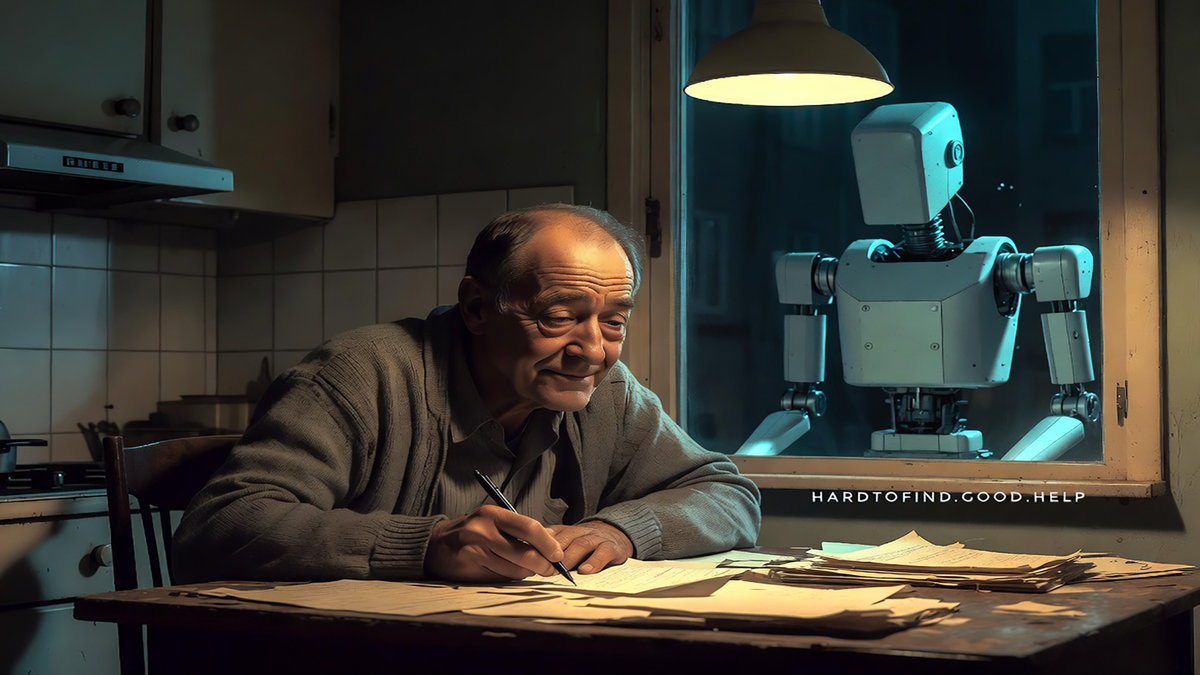
What I keep getting stuck on, in the part of the night when a man gets stuck on things, is that they didn't decide I was a robot because I was cold. I have never been cold a day in my life. They decided it because I was careful. Because I took the time. The one thing I believed I was giving them, all those years, sentence by sentence, turned out to be the thing that finally read as nobody home.
My daughter has softened since. She told me last week that I'm probably not a robot, on the grounds that a robot would have updated by now. I chose to take it as the compliment she didn't quite intend. Then she asked me to stop signing my texts to her. I said I would consider it. I have considered it. The answer, with love, and a comma, is no.